Here’s something most lenders know and most borrowers don’t: the rate printed on your loan documents is not the rate you’re actually paying.
There’s a gap between what’s advertised and what’s real. It’s not hidden in fine print. It’s not illegal. It’s just math — math that lenders understand very well and borrowers almost never hear explained in plain terms.
This article is going to close that gap. Once you understand how your effective interest rate works, you’ll see exactly how the system has been working against you — and more importantly, how you can flip that around and make it work for you instead.
The Rate on Your Paperwork vs. What You’re Actually Paying
When you take out a loan, the rate you’re quoted is called the nominal interest rate. It’s the number in the headline. It’s what gets advertised. And by itself, it doesn’t tell the whole story.
The number that actually matters is your effective interest rate — sometimes called the effective annual rate (EAR). This is the true cost of borrowing once you account for how often interest compounds throughout the year.
Compounding means interest getting charged on interest that has already been added to your balance. And the more often that happens, the more you actually pay — even if the nominal rate never changes.
The formula looks like this:
Effective Interest Rate = (1 + nominal rate ÷ compounding periods)^compounding periods − 1
You don’t need to memorize the formula. But you do need to understand what it means in practice.
How Compounding Frequency Changes What You Actually Pay
Let’s say your loan has a 20% nominal interest rate. Here’s what your effective rate looks like depending on how often interest compounds:
| Compounding Frequency | Effective Annual Rate |
|---|---|
| Annually (once per year) | 20.00% |
| Monthly (12x per year) | 21.94% |
| Daily (365x per year) | 22.13% |
Same 20% rate. But daily compounding means you’re actually paying the equivalent of 22.13% per year — over 2 percentage points more than what the rate card says.
That difference is not accidental. It’s built into the structure of how interest is calculated. And for borrowers who don’t know to look for it, it quietly adds up month after month.
Why This Matters So Much for Credit Cards
Credit cards are where compounding hits hardest — and where most people are the least aware of it.
Most credit cards compound interest daily. They take your annual rate, divide it by 365, and apply that tiny daily rate to your balance every single day. If you carry a balance, yesterday’s interest becomes part of today’s balance, which gets charged interest again tomorrow.
At a 24% nominal rate with daily compounding, your effective annual rate is about 27.11%. That means every dollar of credit card debt you carry for a year actually costs you 27 cents — not 24.
And most people with credit card debt aren’t carrying it for just a year. Some balances sit for years, silently compounding every single day.
Compare that to a mortgage, which typically compounds monthly. A 7% mortgage has an effective rate of about 7.23%. That’s still a small gap from the nominal rate — but the difference between the structure of a mortgage and the structure of a credit card is enormous.
Here’s a side-by-side look at common debt types and how compounding affects what you’re actually paying:
| Debt Type | Typical Nominal Rate | Compounding Frequency | Approximate Effective Rate |
|---|---|---|---|
| Credit card | 20–29% | Daily | 21.9% – 33.6% |
| Personal loan | 10–20% | Monthly | 10.5% – 21.9% |
| Auto loan | 6–10% | Monthly | 6.2% – 10.5% |
| Student loan (federal) | 5–8% | Daily | 5.1% – 8.3% |
| Mortgage | 6–8% | Monthly | 6.2% – 8.3% |
The pattern is clear: the debts with the highest rates also compound most aggressively. Credit card companies aren’t just charging you more — they’re also structured to squeeze the most out of every dollar you owe.
This is how the system was built. And it’s been working against you the whole time.
Flipping the Script
Here’s where it gets interesting.
The same math that works against you as a borrower can be reversed to work for you. You don’t need to change your interest rate to lower your effective cost of debt. You just need to understand how principal and compounding interact — and use that to your advantage.
The core idea: Interest is calculated on your outstanding balance. The faster you reduce your balance, the less interest can compound on.
Every extra dollar you put toward principal is a dollar that will never have interest charged on it again. Over the life of a long loan, that effect multiplies.
Here are three ways to put this into practice:
1. Make Extra Payments
If you have a $300,000 mortgage at 7% over 30 years, your standard monthly payment is about $1,996. Your total interest paid over 30 years: roughly $418,527.
Now suppose you add just $200 per month to your payment — $2,196 total. That extra $200 goes directly to principal. Here’s what happens:
| Standard Payment | +$200/Month | |
|---|---|---|
| Payoff time | 30 years | ~24 years, 4 months |
| Total interest | ~$418,527 | ~$313,400 |
| Interest saved | — | ~$105,000 |
You didn’t change your rate. The lender didn’t give you a discount. You just used the math against the compounding instead of letting it work against you.
2. Switch to Bi-Weekly Payments
Instead of making one monthly mortgage payment, split it in half and pay every two weeks.
Here’s why this works: there are 52 weeks in a year. Bi-weekly payments means 26 half-payments — which equals 13 full monthly payments instead of 12. You’re making one extra payment per year without it feeling like it.
On a $300,000 mortgage at 7%, switching to bi-weekly payments alone can:
• Pay off your loan about 4–5 years early
• Save roughly $60,000–$70,000 in interest
Again — no rate change. Just a smarter structure.
3. Target High-Rate, Daily-Compounding Debt First
If you’re carrying both credit card debt and a mortgage, the math strongly favors attacking the credit card first. Every dollar you put toward a 24% daily-compounding credit card balance saves you far more than the same dollar applied to a 7% monthly-compounding mortgage.
This is the logic behind common debt payoff strategies that prioritize highest-rate debt first. The compounding math backs it up completely.
How Refinancing Fits In
When you refinance, you’re not just getting a different interest rate. You’re potentially changing the compounding structure of your debt — and that matters more than most people realize.
A cash-out refinance that rolls high-rate credit card debt into a mortgage does two things at once:
First: It drops the nominal rate dramatically. Going from 24% to 7% is obvious.
Second: It changes the compounding frequency from daily to monthly. That shift alone reduces your effective rate even before the rate difference is factored in.
In plain terms: you’re moving debt from the most aggressive compounding structure (daily, high-rate) to a more favorable one (monthly, low-rate). The compounding math that was working hardest against you gets neutralized.
A refinance also lets you reset how principal is paid down on your remaining mortgage balance. If you choose a shorter term, more of every payment goes toward principal from day one — which reduces the amount that compounds over the life of the loan.
This doesn’t mean every refinance is the right move. Closing costs, your remaining loan term, your break-even point, and your interest rate all matter. But understanding the effective rate — and how compounding changes — gives you a more complete picture of what a refinance is actually doing for you.
[See the full impact for your situation →] https://shouldirefi.app/tool/calculator
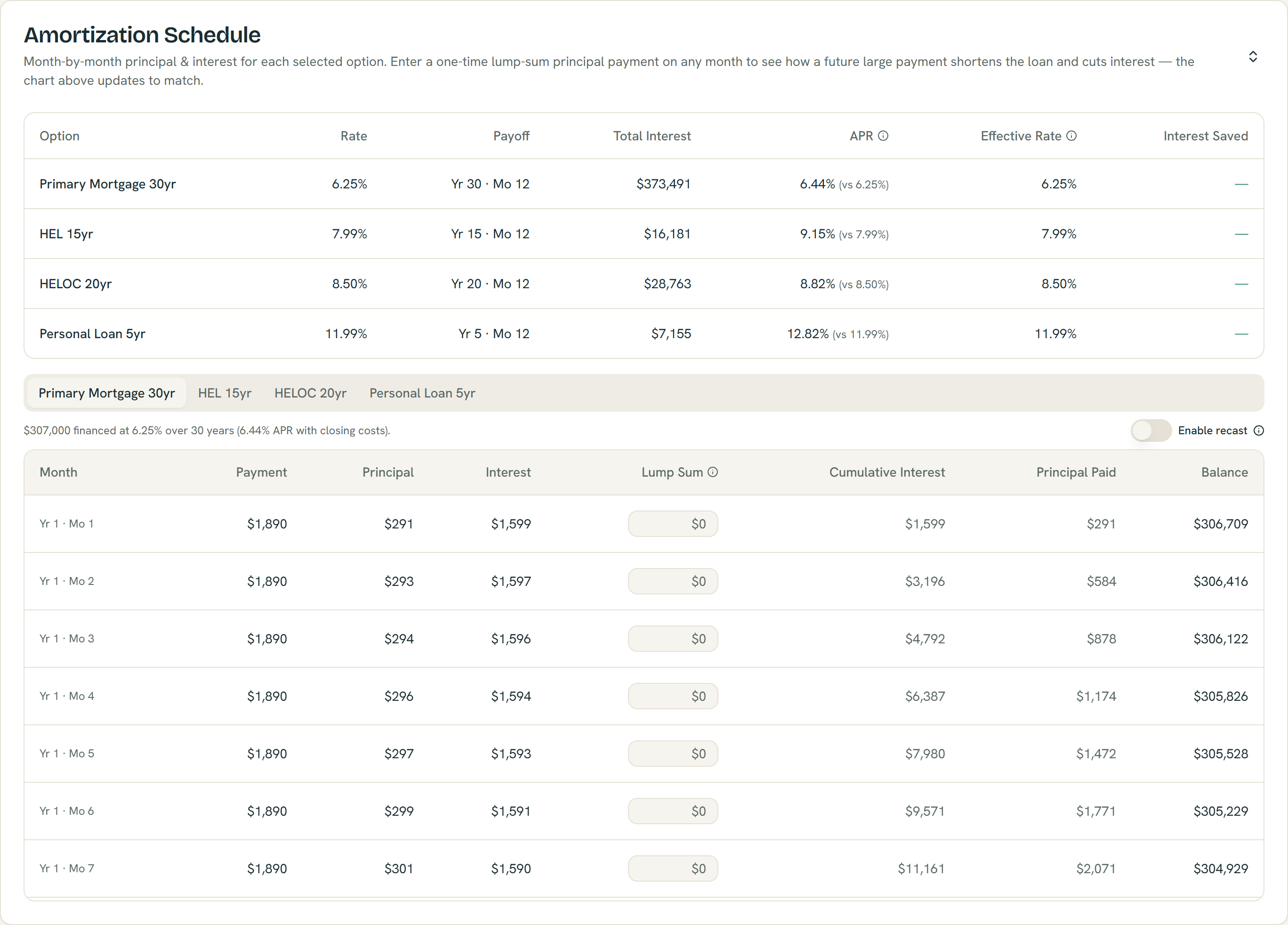
The Amortization Schedule breaks down every payment and lets you model one-time lump sums — with an optional recast — from example inputs; estimates only.
What to Do With This Information
You now know something most borrowers don’t. Here’s how to apply it:
Look at every debt you’re carrying and ask two questions: What is the nominal rate? And how often does it compound? That gives you a clearer picture of your true cost of debt — not just the number on your statement.
Then, if you have room to make extra payments, direct them to the highest-rate, most-frequently-compounding debt first. You don’t need to pay a lot extra to make a meaningful difference. Even small amounts of extra principal, applied consistently, can save tens of thousands of dollars over the life of a loan.
And if you’re a homeowner carrying high-rate debt, it’s worth modeling whether a refinance — or a cash-out refinance that consolidates that debt — would actually improve your overall picture. The compounding difference alone might surprise you.
[Run your numbers in the ShouldIRefi Calculator →] https://shouldirefi.app/tool/calculator
The calculator lets you compare your current debt situation against scenarios like a cash-out refinance or extra payments — and see exactly how much interest you’d save over time. You can also see your weighted average interest rate across all your debts, which gives you a starting point for understanding your effective cost of debt overall.
Not sure where to begin? [Start with the Financial Audit] _https://shouldirefi.app/tool/audit_— it walks you through your full financial picture step by step and loads everything into the calculator automatically. From there, the math does the work.