Most people make major financial decisions — refinancing, taking out a personal loan, changing student loan plans — without a clear picture of their full financial situation. They focus on one number (like a new interest rate) and miss the bigger picture.
A financial audit changes that. It means taking a structured look at everything: your income, your debts, your monthly expenses, and your goals. With that information in front of you, the right decision becomes a lot clearer — and bad ones become easier to avoid.
Here's how to think about it.
What Is a Personal Financial Audit?
A personal financial audit is simply a deliberate review of your current money situation. It's not about judging your past decisions — it's about getting clarity on where you stand today so you can make better choices going forward.
Think of it the same way a business reviews its books before making a major investment. You wouldn't decide to take on debt without first knowing what you owe, what you earn, and what you spend. The same logic applies to your personal finances.
Step 1: Know Your Income
Start with what's coming in each month. Use your gross monthly income (before taxes) since that's what lenders use to calculate DTI and other ratios.
Include:
- Salary or wages (yours and a partner's, if applicable)
- Self-employment or freelance income (use a consistent average)
- Rental income
- Any other regular income sources
Step 2: List Every Debt
Write down every debt you have. For each one, record:
- The outstanding balance
- The interest rate
- The minimum monthly payment
- The loan type (mortgage, credit card, auto loan, student loan, HELOC, personal loan, etc.)
This list is the foundation of any debt decision. You can't compare payoff strategies or refinance options without knowing what you're actually working with.
Step 3: Track Monthly Expenses
Beyond debt payments, what does your monthly life actually cost?
Include:
- Housing costs (rent, mortgage, property taxes, insurance, HOA)
- Utilities
- Groceries and household
- Transportation
- Insurance (health, auto, life)
- Childcare or education costs
- Subscriptions and other recurring expenses
Understanding your total monthly outflow — both debt payments and living expenses — tells you how much breathing room you actually have.
Step 4: Know Your Home's Value (If You Own)
If you own a home, your property value and how much you owe on your mortgage determine how much equity you have — and how much you can potentially borrow through a cash-out refinance, HELOC, or home equity loan.
Get a rough estimate of current value (recent sales of similar homes, an online estimator, or a formal appraisal) and subtract your mortgage balance. That's your equity.
This single number can open or close a lot of options.
Step 5: Calculate Your Key Ratios
With the numbers above, you can now calculate the ratios that lenders use — and that you should understand:
Debt-to-Income (DTI): Total monthly debt payments ÷ Gross monthly income × 100 Under 36% is generally healthy. Above 43% starts to limit your loan options.
Loan-to-Value (LTV) — homeowners: Mortgage balance ÷ Home value × 100 Under 80% is the threshold for the most options and best rates.
Total expense ratio: (Debt payments + other monthly expenses) ÷ Gross monthly income × 100 This tells you how much of your income is genuinely committed each month.
Residual income: Gross monthly income − all monthly obligations What's left over for flexibility, savings, or extra debt payments.
Step 6: Define Your Goal
Before choosing any debt strategy or loan product, be clear about what you're actually trying to accomplish. Common goals:
- Lower my monthly payment
- Pay off debt as fast as possible
- Consolidate multiple debts into one payment
- Access cash for home improvements or other expenses
- Reduce my total interest paid over time
- Improve my DTI before applying for a mortgage
Different goals lead to different answers. The "right" refinance for someone trying to lower their monthly payment is different from the right move for someone trying to build equity as fast as possible.
Why This Matters Before Any Major Decision
Without this full picture:
- You might refinance into a lower payment but pay more total interest over time
- You might take on a home equity loan without realizing your LTV is already too high
- You might miss that a personal loan would save more than a cash-out refi for your specific situation
- You might misstate income or debts on a loan application
With this full picture, the comparisons become clear.
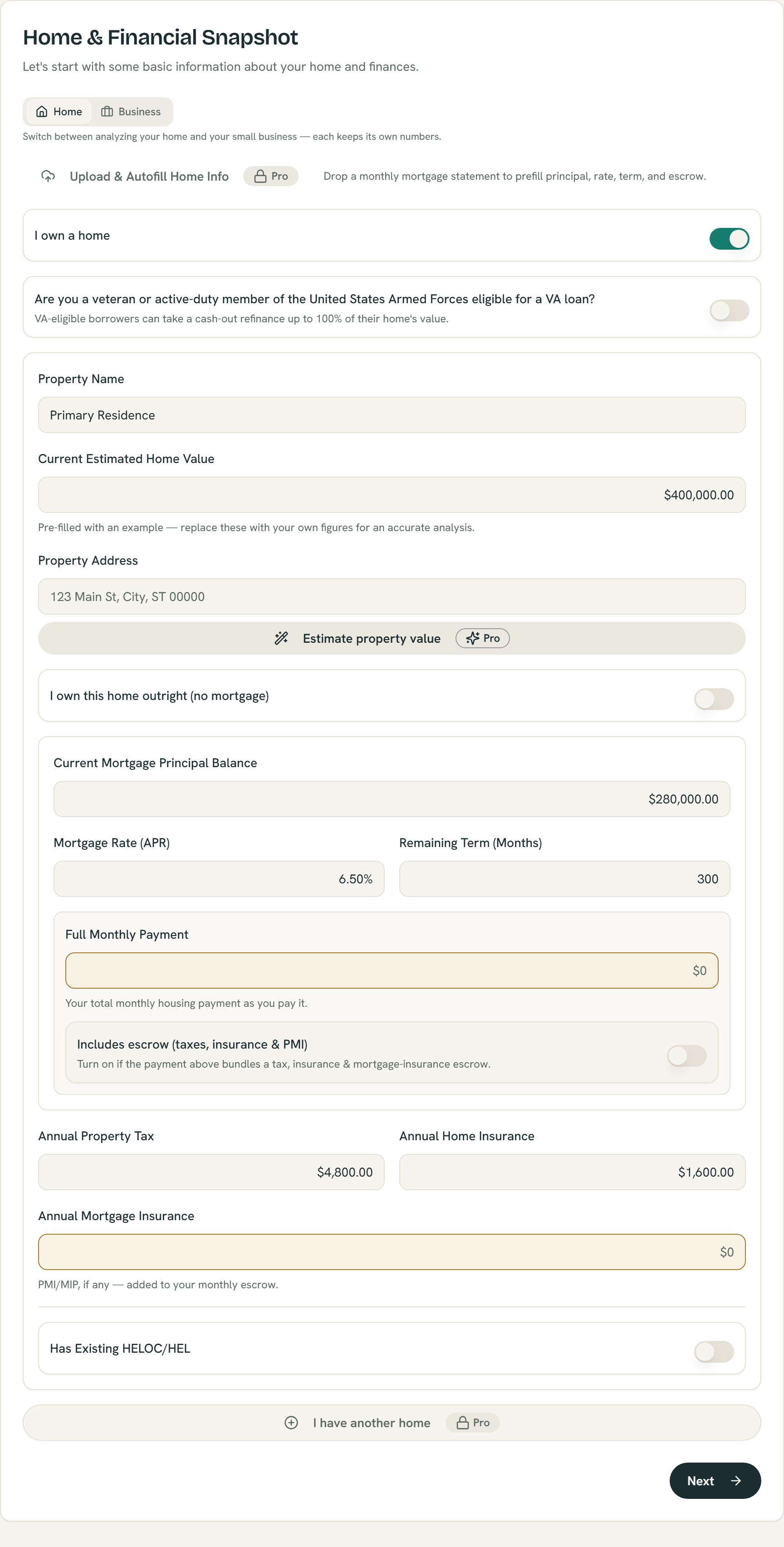
The audit collects each number step by step — every field maps to a line on your statement — and pre-fills the calculator when you finish.
The Fastest Way to Do This
Going through all of these steps manually takes time — but the ShouldIRefi Financial Audit (https://shouldirefi.app/tool/audit) was built to walk you through exactly this process.
It's a guided questionnaire that collects your full financial picture — property details (optional), mortgage and HELOC balances, all your debts, income, and monthly expenses — and then loads everything directly into the Calculator.
From there, you can compare refinancing options, personal loan scenarios, self-pay strategies, and student loan plans side by side, using your real numbers.
Start the Financial Audit → (https://shouldirefi.app/tool/audit)
It's free to use and takes about 10–15 minutes. If you'd rather jump straight to the numbers, you can also go directly to the Calculator (https://shouldirefi.app/tool/calculator) and fill in your details manually.