You've got some extra money each month. Maybe a raise came through, or you cut an expense and freed up cash. Now the question: do you use it to pay down debt faster, or put it to work by investing?
Both are good goals. But they're competing for the same dollars — and which one wins depends a lot on your specific situation.
The Core Tradeoff
Here's the fundamental math:
- Paying off debt gives you a guaranteed return equal to the interest rate on that debt. If you pay off a credit card charging 22%, that's like earning 22% on your money — with zero risk.
- Investing can potentially earn more over time, but it comes with risk and uncertainty. Stock market returns average roughly 7–10% annually over long periods, but any given year could be a loss.
The comparison is straightforward in theory: if your debt's interest rate is higher than what you'd expect to earn by investing, paying off debt wins on the math. If your debt's interest rate is lower, investing may come out ahead.
A Common Guideline: The 6% Rule
A widely used rule of thumb: if your debt carries an interest rate of 6% or higher, prioritize paying it off before investing extra dollars (beyond any employer 401(k) match you're getting).
If your debt is below 6% — like a low-rate mortgage or subsidized student loan — investing may make more mathematical sense, since you're more likely to earn more in the market over time than you'd save in interest.
This isn't a perfect rule for everyone, but it gives a useful starting point.
But There Are Exceptions
Always get your employer 401(k) match first. If your employer matches retirement contributions, that's an immediate 50–100% return on your money. Even if you carry high-interest debt, capturing the full match is usually worth it before accelerating debt payoff.
Build an emergency fund first. Putting all extra cash into debt or investments without a safety net is risky. If an unexpected expense hits — car repair, medical bill, job loss — you may end up going right back into high-interest debt. Most financial experts recommend having 3–6 months of essential expenses saved before aggressively paying down debt.
High-interest debt changes everything. Credit card debt at 20–25% interest is almost always worth paying off before investing in anything. There's no investment that reliably beats a guaranteed 20%+ return.
The Psychological Side
Math doesn't always win. For many people, carrying debt causes stress — and being debt-free has a real value beyond the numbers. If your debt is keeping you up at night, paying it off faster may be the right call even if the math doesn't perfectly support it.
On the flip side, some people find it motivating to watch investments grow. If investing keeps you engaged and consistent with your money, that habit can be worth a lot too.
The best strategy is one you'll actually stick with.
What About Investing INSTEAD of Paying Off a Mortgage?
For homeowners, this question gets interesting. Your mortgage rate might be 5–7%. Market returns have historically averaged more than that over long periods. So mathematically, it might seem like you'd come out ahead investing instead of making extra mortgage payments.
The tricky part: investing returns aren't guaranteed, but mortgage interest is. And paying off a mortgage early reduces risk and builds equity — a tangible asset you own outright.
Many people choose a middle path: make some extra mortgage payments while also investing a portion of their extra cash.
See Both Paths for Your Actual Numbers
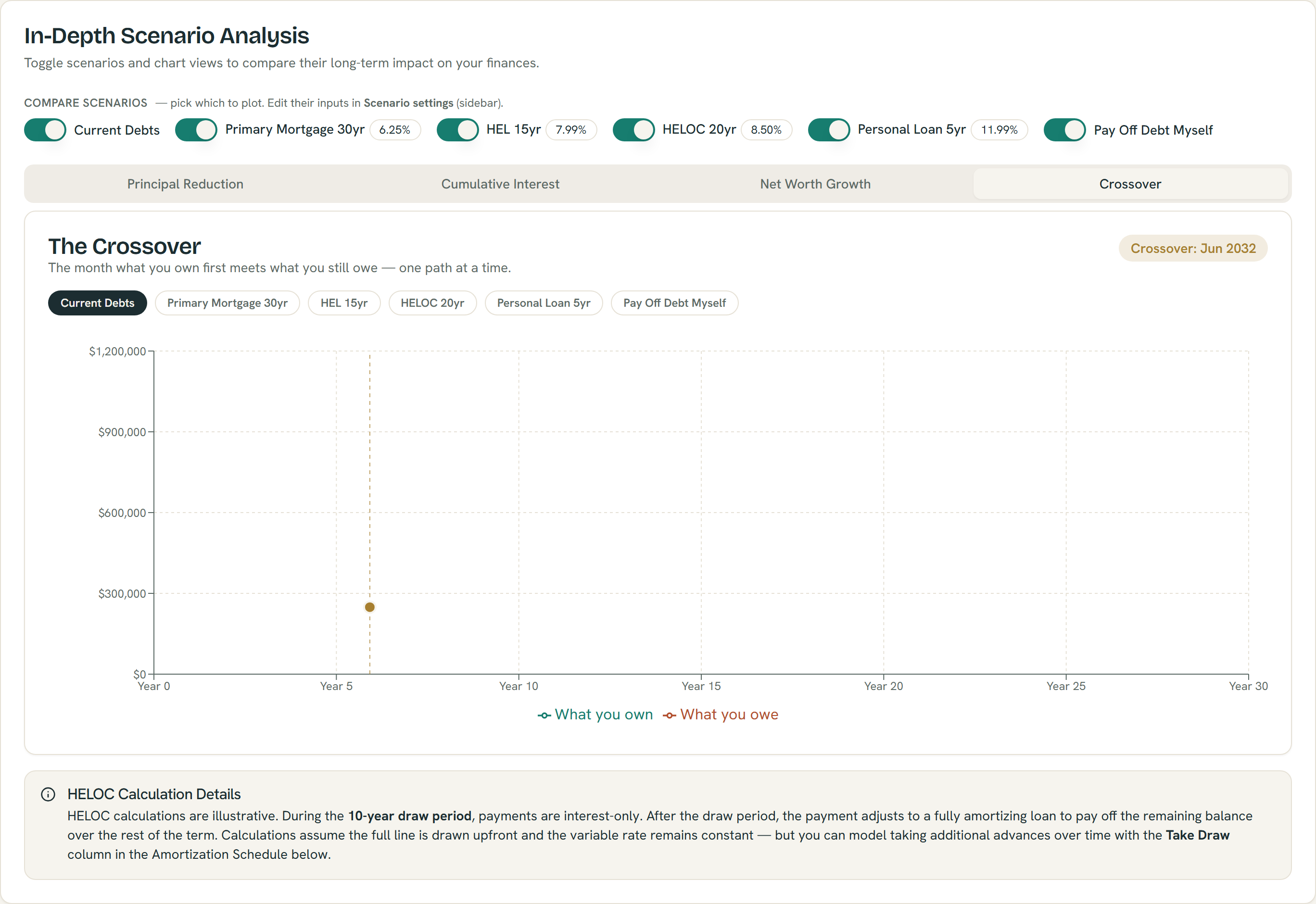
The Crossover view charts what you own against what you owe and marks the month they meet — example data; estimates only.
This is exactly the kind of decision the ShouldIRefi Calculator was built to help with.
Try the ShouldIRefi Calculator → (https://shouldirefi.app/tool/calculator)
The calculator includes an investment toggle that lets you compare two scenarios side by side:
- Use extra savings to accelerate debt payoff
- Grow those savings as an investment instead
You can see total interest paid, projected asset growth, and net worth trajectory under each approach — using your real numbers, not hypotheticals.
It's one of the most powerful features of the tool and takes just minutes to set up.
Try it free → (https://shouldirefi.app/tool/calculator)
Not sure where to start? Take the Financial Audit (https://shouldirefi.app/tool/audit) to map your full financial picture first.