Here's the strangest arithmetic in business valuation: you can pay someone $300,000 a year and become $1.2 million richer.
The worked example
A business throws off $1M of SDE with the owner running it day to day. Owner-operated Main Street businesses price on SDE — call it 3× for this one:
$1,000,000 SDE × 3 = $3,000,000
Now the owner hires a $300K general manager and steps back. Earnings drop to $700K — but the business is no longer buying a job, it's a standalone machine, and machines price on EBITDA multiples, which run higher (roughly 3–6× at this size, more with recurring revenue):
$700,000 EBITDA × 6 = $4,200,000
Same customers, same trucks, same P&L except one salary line — and $1.2M more enterprise value, because the business crossed from the SDE market (individual buyers who must work in it) into the EBITDA market (investors and small PE funds who don't).
Why the multiple jumps
Buyers don't pay for earnings; they pay for earnings they believe will survive the handover. Owner dependence is the single biggest multiple killer on Main Street. A manager in place, documented systems, and a business that runs without its founder don't just add a salary expense — they remove the buyer's biggest risk, widen the buyer pool, and often push the business across the ~$1M-EBITDA line where financial buyers start competing.
When it destroys value instead
This is not a universal move, and the math is honest about it. A business with $165K of SDE hiring a $75K manager drops to $90K of EBITDA — and even at a higher multiple, that's less than the SDE-basis value. At Main Street scale, the salary eats more than the multiple adds. The play works when earnings are large enough that the manager's cost is small relative to the basis switch — typically approaching $1M+ of SDE.
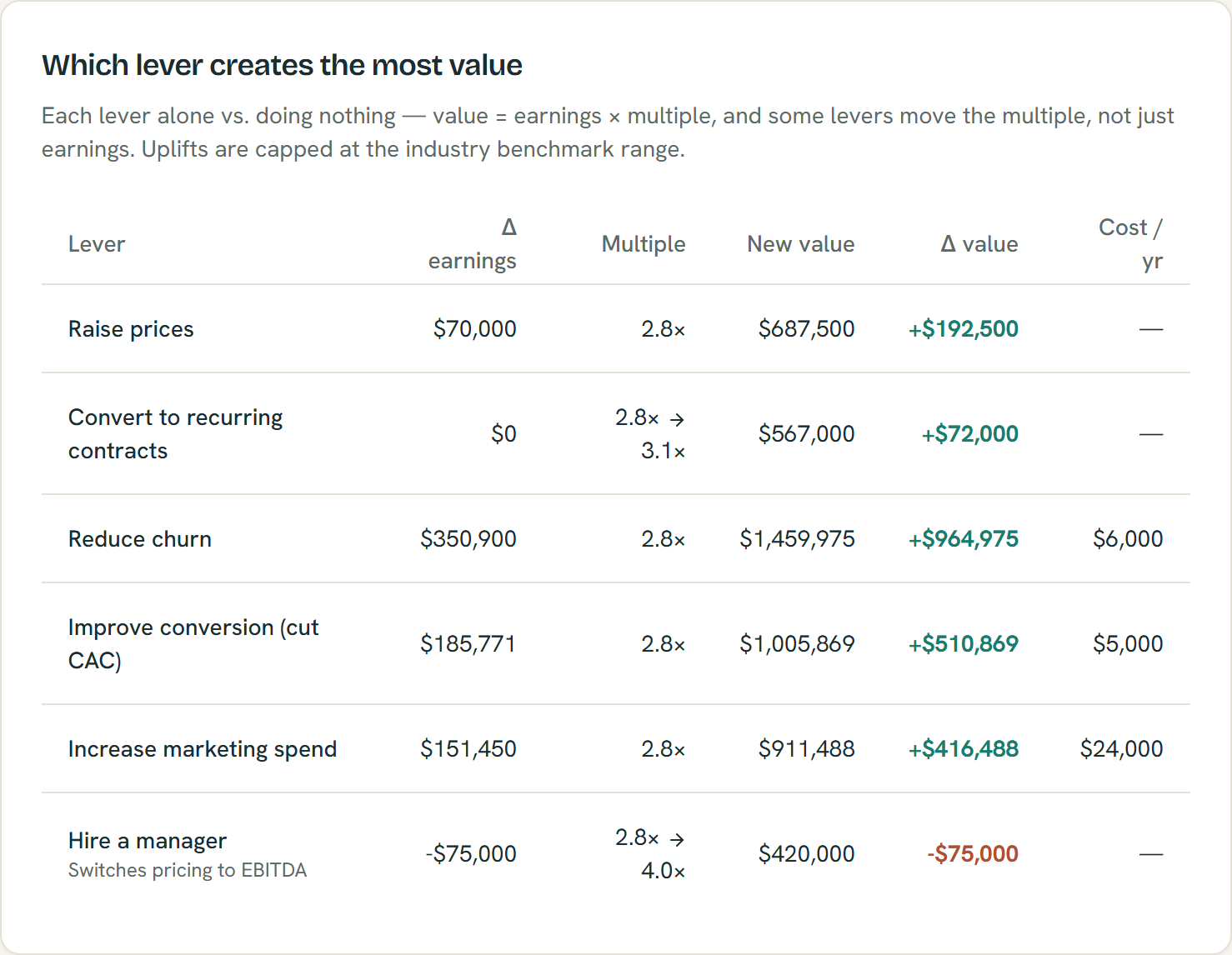
Each growth lever ranked by enterprise value created per dollar — note the manager hire switching the pricing basis — example data; estimates only.
Test it on your own numbers
Our Growth Calculator models the manager hire as one of six growth levers on the dual-lever value model (value = earnings × multiple) — it switches the pricing basis, re-grades the risk profile, caps the multiple at documented industry ranges, and ranks the result against cheaper levers like churn reduction and pricing. Sometimes the seven-figure move is hiring your replacement; sometimes it's a 5% price increase. The table will tell you which — as an estimate from transaction benchmarks, not an appraisal.
Sellers who walk in knowing their SDE, their EBITDA, and which basis their buyer prices on land within 10–15% of final price at first offer. Unprepared sellers leave 20–30% on the table. Be the first kind.